Databases are the backbone of modern applications, helping businesses store, organize, and retrieve data efficiently. But with so many types of databases available, it can be tricky to decide which one fits your needs best. In this blog, we’ll break down three popular database models, Document, Relational, and Graph, explaining their differences, use cases, and when you should pick one over the other.
The short version
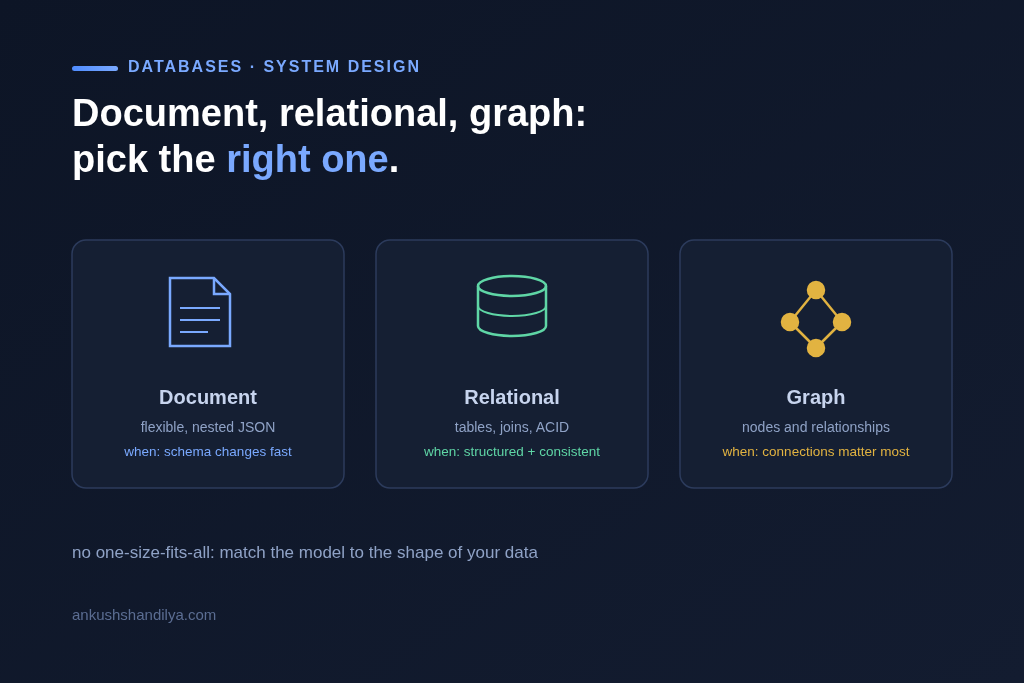
Pick relational when your data is structured and consistency matters, document when the schema changes often, and graph when the relationships between records are what you query most. There is no universally best model, only the one that matches the shape of your data. The rest of this post is each model, how it works, and when to reach for it.
1. Document Databases: Storing Data Like JSON Objects
What is a Document Database?
A document database stores data in a flexible, semi-structured format, typically using JSON or BSON documents. Instead of tables with rows and columns (like relational databases), document databases store entire objects, making them great for applications where data structures vary.
How it Works
Each document contains key-value pairs, lists, or nested structures, allowing developers to store complex data in a single record. This eliminates the need for multiple tables and joins.
Pros of Document Databases:
- Flexible schema: No predefined structure; each document can have different fields.
- Fast read/write operations: Ideal for handling large volumes of unstructured or semi-structured data.
- Great for hierarchical data: JSON-like structures make it easy to model real-world objects.
Best Use Cases:
- Content management systems (e.g., blogs, e-commerce platforms)
- Real-time analytics and logging
- Applications requiring frequent schema changes
Popular Document Databases:
- MongoDB
- CouchDB
- Firebase Firestore
2. Relational Databases: Structured and Organized
What is a Relational Database?
A relational database organizes data into tables with predefined schemas, using structured query language (SQL) for queries. Relationships between tables are maintained using foreign keys, ensuring data integrity.
How it Works
Data is stored in a highly structured manner, with clear relationships between different tables. This makes relational databases reliable for applications that require consistency and transactional integrity.
Pros of Relational Databases:
- Strong data integrity: Ensures accuracy and consistency with ACID (Atomicity, Consistency, Isolation, Durability) compliance.
- Standardized querying: SQL makes it easy to perform complex queries and aggregations.
- Ideal for transactional systems: Great for applications that require a well-structured data format.
Best Use Cases:
- Banking and financial applications
- E-commerce platforms with structured product catalogs
- Enterprise resource planning (ERP) systems
Popular Relational Databases:
- MySQL
- PostgreSQL
- Microsoft SQL Server
3. Graph Databases: Relationships at the Core
What is a Graph Database?
A graph database focuses on relationships between data points, using nodes (entities) and edges (connections). Instead of relying on tables and joins, it efficiently navigates relationships, making it ideal for highly interconnected data.
How it Works
Each entity (node) stores properties, and connections (edges) define relationships between nodes. This structure makes graph databases incredibly powerful for analyzing complex networks.
Pros of Graph Databases:
- Efficient relationship handling: Queries on relationships are faster than traditional joins in relational databases.
- Great for complex networks: Easily models social networks, recommendation systems, and fraud detection.
- Scalability: Handles growing datasets efficiently.
Best Use Cases:
- Social media and recommendation engines
- Fraud detection and cybersecurity
- Supply chain and logistics optimization
Popular Graph Databases:
- Neo4j
- Amazon Neptune
- ArangoDB
Which Database Should You Choose?
| Feature | Document Database | Relational Database | Graph Database |
|---|---|---|---|
| Schema | Flexible | Fixed | Flexible |
| Query Language | NoSQL (JSON-like queries) | SQL | Graph Query Language (Cypher, Gremlin) |
| Performance | Fast for reads/writes | Efficient for structured data | Optimized for relationships |
| Best For | Semi-structured data | Structured transactional data | Complex relationships |
Final Thoughts
There’s no one-size-fits-all database. Each model serves a different purpose. If you need flexibility, go with a document database. If data integrity and structure are crucial, choose a relational database. If relationships are at the heart of your application, a graph database is the way to go.
Understanding the strengths and weaknesses of each model will help you make an informed choice for your project. Need help with database optimization or migration? Reach out, and let’s find the best solution for you!
Frequently asked questions
What is the difference between document, relational, and graph databases?
A relational database stores data in tables with rows and columns and enforces a fixed schema, which is ideal for structured, consistent data. A document database stores flexible, nested JSON-like documents, which suits data whose shape changes often. A graph database stores nodes and the relationships between them, which is best when the connections between records are the main thing you query.
When should I use a graph database instead of a relational one?
Use a graph database when relationships are the core of your queries, such as social networks, recommendations, or fraud detection, where you traverse many hops between connected records. A relational database can model relationships with joins, but those joins get slow and complex as the depth of connections grows. If your questions are mostly about how things connect, a graph database fits.
Can I use more than one type of database in the same application?
Yes, and large systems often do. This is called polyglot persistence: you pick the database that fits each part of the workload, for example a relational database for billing, a document store for flexible product data, and a graph database for recommendations. The tradeoff is added operational complexity, so only split when a single database genuinely stops fitting.
Related: Choosing a database is one half of performance; how you cache what it returns is the other. See the six layers of caching.